 Emergency
 Ambulance






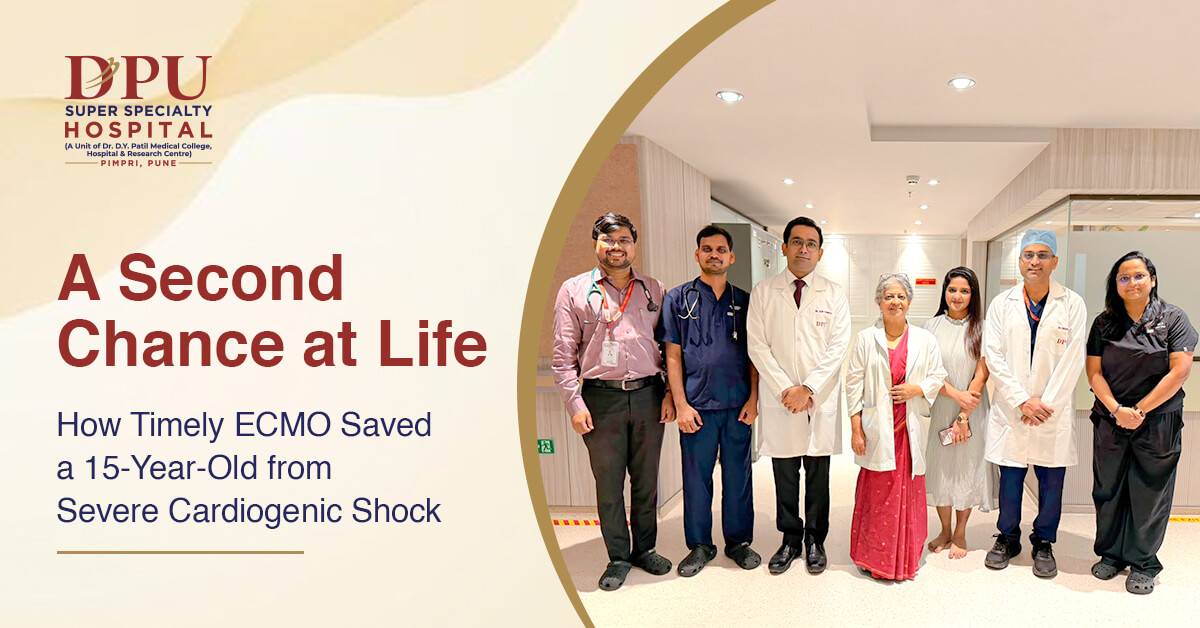
A Second Chance at Life: How Timely ECMO Saved a 15-Year-Old from Severe Cardiogenic Shock
What started as an ordinary morning with mild weakness, giddiness, and an upset stomach quickly escalated into a fight for survival.
On August 27, a determined 15-year-old girl pushed through feeling unwell to sit for her scheduled exam. Within hours, her health took a dramatic turn, developing into fulminant viral myocarditis a severe, sudden inflammation of the heart muscle that led to life-threatening refractory cardiogenic shock.
Her heart was failing rapidly, unable to pump enough oxygen-rich blood to sustain her vital organs despite maximum medication support. Every minute mattered.
The Race Against Time: Mobilising Advanced Life Support
Recognising the acute crisis, the specialised ECMO retrieval team from DPU Super Specialty Hospital, Pimpri, Pune, was mobilised that night.
Equipped with portable life-support systems and accompanied by cardiac specialists, the team reached her bedside. Because her condition was rapidly worsening, they made the critical decision to perform emergency cannulation and initiate VA-ECMO (Veno-Arterial Extracorporeal Membrane Oxygenation) on the spot as part of the retrieval process, keeping her hemodynamically stable during transport.
What is VA-ECMO?
Extracorporeal Membrane Oxygenation (ECMO) acts as a temporary artificial heart and lung system outside the body. It draws blood, removes carbon dioxide, enriches it with oxygen, and pumps it directly back into arterial circulation.
In acute heart failure, VA-ECMO takes over the mechanical workload of the heart, preserving vital organ function and buying valuable time for the injured heart muscle to rest, recover, and heal.
The Recovery Journey: 8 Critical Days on ECMO
Upon reaching DPU Super Specialty Hospital, the patient was placed under round-the-clock intensive care.
- August 27 — Emergency Retrieval: Rapid bedside initiation of VA-ECMO stabilised her blood pressure and oxygenation during transit.
- 8 Days of Specialised Support: Continuous hemodynamic monitoring allowed her heart muscle inflammation to subside, while doctors gradually reduced ECMO flow.
- September 4 — Successful Weaning: Her cardiac function rebounded significantly, allowing the medical team to decannulate her from ECMO and safely extubate her.
- Comprehensive Step-Down Care: The focus shifted toward physical therapy, nutritional support, and monitored rehabilitation.
- September 15 — Heading Home: After three weeks of coordinated care, she was discharged home in stable condition and neurologically intact.
A Coordinated Multidisciplinary Triumph
Saving a patient in refractory cardiogenic shock requires an entire coordinated system responding within minutes.
Her management was spearheaded by the Department of Critical Care Medicine:
- Dr. Prachee Sathe (Professor & Head)
- Dr. Asir Tamboli (Associate Professor & In-charge)
- Dr. Riddhi Kundu (Assistant Professor)
They worked hand-in-hand with the Cardiovascular and Thoracic Surgery (CVTS) team including Dr. Mahesh, Dr. Ashish Dolas, and Dr. Ashish Baviskar alongside dedicated perfusionists, cardiac anesthesiologists, intensive care nursing staff, respiratory care experts, and rehabilitation specialists.
"ECMO is not simply the deployment of a machine; it requires an entire system of care. The success of an ECMO case depends on rapid decision-making, skilled cannulation, continuous monitoring, and the coordinated efforts of intensivists, perfusionists, nurses, and allied specialists."
— Dr. Prachee Sathe, Professor and Head, Department of Critical Care Medicine
Frequently Asked Questions (AEO / FAQ Schema Ready)
What is cardiogenic shock in pediatric and teenage patients?
Cardiogenic shock occurs when the heart suddenly cannot pump sufficient blood and oxygen to vital organs such as the brain, liver, and kidneys. In teenagers and young adults, it is frequently triggered by fulminant viral myocarditis—an aggressive inflammatory reaction of the heart tissue often following an otherwise routine viral infection.
How does VA-ECMO save lives during acute heart failure?
Veno-Arterial Extracorporeal Membrane Oxygenation (VA-ECMO) redirects deoxygenated blood outside the body, infuses it with oxygen, removes carbon dioxide, and returns it directly into an artery under physiologic pressure. This bypasses the heart’s workload entirely, preventing multi-organ failure and providing a critical window for the heart muscle to recover.
When should someone seek emergency care for sudden heart symptoms?
Emergency evaluation is essential if common symptoms like nausea, upset stomach, or fever are accompanied by sudden dizziness, fainting (syncope), rapid or irregular heartbeat, acute shortness of breath, or cold and pale extremities.
DPU Super Specialty Hospital, Pimpri, Pune, provides 24/7 advanced critical care, cardiothoracic surgical intervention, and emergency ECMO retrieval services across the region. In a medical emergency, contact our 24/7 critical care helpline.
```