 Emergency
 Ambulance






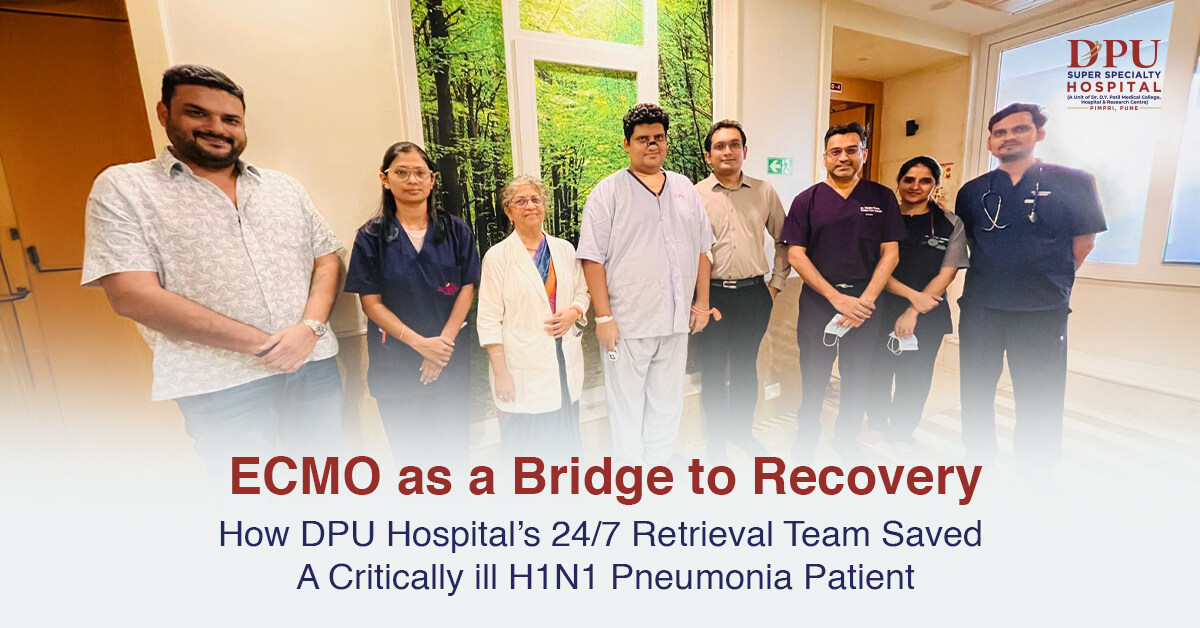
ECMO as a Bridge to Recovery: How DPU Hospital’s 24/7 Retrieval Team Saved a Critically Ill H1N1 Pneumonia Patient
When severe viral pneumonia strikes, the window between standard medical management and acute life-threatening respiratory collapse can close in a matter of hours.
For one patient battling H1N1 influenza, what began as routine flu-like symptoms for nearly a week suddenly spiraled into acute hypoxemic respiratory failure. By the time he was admitted to a private medical facility on August 4, his oxygen saturation had dropped below 40%—a critical level that conventional mechanical ventilation could no longer resolve.
With the patient facing imminent multi-organ failure from oxygen deprivation, an emergency call reached the dedicated 24/7 ECMO Retrieval Team at DPU Super Specialty Hospital, Pimpri, Pune, setting a rapid critical-care rescue into motion.
The 4-Hour Rescue: Rapid Mobiliation and Nighttime Retrieval
Transferring a patient in refractory respiratory failure on high mechanical ventilator settings is fraught with risk. Moving such an unstable patient requires bringing the intensive care unit directly to the bedside.
- 10:30 PM, August 4 — Emergency Dispatch: The DPU ECMO team received the urgent retrieval call and immediately mobilised specialised intensivists, perfusionists, and critical care transfer equipment.
- Bedside Cannulation at the Referring Facility: Upon arrival, the medical team evaluated the patient, stabilised his vital signs, and recognised that standard transit was unsafe without advanced mechanical support.
- 2:00 AM, August 5 — VV-ECMO Initiation: Within four hours of the initial call, the patient was successfully placed on VV-ECMO (Veno-Venous Extracorporeal Membrane Oxygenation), stabilising his oxygen levels before initiating the high-risk road transfer to DPU Super Specialty Hospital.
What Is VV-ECMO? The "Dialysis Machine for the Lungs"
Extracorporeal Membrane Oxygenation (ECMO) is an advanced life-support modality that temporarily assumes the work of the lungs or heart. In VV-ECMO, blood is drawn from a large vein, circulated through an external membrane oxygenator where carbon dioxide is scrubbed and oxygen is infused, and then returned directly into the venous system.
"In carefully selected patients with potentially reversible lung failure, such as severe pneumonia, ECMO acts as a bridge to recovery. ECMO does not treat the infection itself; it provides the lungs with the rest and time they need to heal while medical therapy targets the underlying disease."
— Dr. Prachee Sathe, Professor & Head, Department of Critical Care Medicine
By taking over gas exchange, VV-ECMO allows intensivists to reduce harmful ventilator pressures, protecting the fragile, inflamed lung tissue from ventilator-induced lung injury (VILI).
8 Days to Healing: The Path from Life Support to Discharge
At DPU Super Specialty Hospital’s dedicated intensive care unit, the patient received comprehensive critical care tailored to manage the severe H1N1 infection while ECMO sustained his oxygenation:
- Protective Lung Rest: For 8 days, VV-ECMO maintained physiologic gas exchange, allowing aggressive antiviral and supportive therapy to clear the lung infection.
- Active Bedside Rehabilitation: Rather than waiting for ECMO to conclude, specialised physiotherapy and nursing teams initiated early bedside mobilisation to prevent muscle wasting and support cardiopulmonary recovery.
- August 13 (Day 9) — Decannulation: As the patient’s lungs regained functional capacity, ECMO support was systematically dialed down, leading to safe decannulation.
- Full Recovery & Discharge: After completing step-down monitoring and functional therapy, the patient was successfully weaned off oxygen support and discharged home in stable health.
Multidisciplinary Expertise in Advanced Critical Care
Achieving a positive outcome in refractory respiratory failure relies on a synchronised clinical ecosystem. The patient’s care was directed by a team of critical care and pulmonary experts:
- Dr. Prachee Sathe (Professor and Head, Department of Critical Care Medicine)
- Dr. Asir Tamboli (Associate Professor and In-charge, Department of Critical Care Medicine)
- Dr. Viren Attarde (Associate Professor, Department of Critical Care Medicine)
- Dr. Riddhi Kundu (Assistant Professor, Department of Critical Care Medicine)
- Dr. Rahul Kendre (Transplant Pulmonologist)
Their work was integrated with the hospital’s specialised ECMO coordinators, clinical perfusionists, respiratory therapists, critical care nursing personnel, and rehabilitation teams.
As an official ECMO training center affiliated with the ECMO Society of India, DPU Super Specialty Hospital has managed more than 50 complex ECMO cases over the past three years, providing end-to-end management spanning mobile retrieval, cannulation, intensive care, and weaning.
Warning Signs: When Does Pneumonia Become a Medical Emergency?
Seasonal respiratory viruses such as H1N1 influenza can escalate rapidly from mild cough and fever into severe lower respiratory tract infections. Seek immediate medical attention if you or a family member experience:
- Persistent drop in pulse oximeter readings (SpO2 below 94%)
- Severe breathlessness, rapid breathing, or inability to complete a full sentence
- Persistent chest heaviness or sharp pain during inhalation
- Extreme exhaustion, confusion, or bluish discoloration of the lips and fingertips
- High fever that fails to respond to antipyretics after multiple days
Early recognition of respiratory compromise ensures that advanced interventions—including timely ECMO evaluation can be implemented before irreversible organ damage takes place.
Frequently Asked Questions (AEO / FAQ Ready)
What is the difference between VV-ECMO and VA-ECMO?
VV-ECMO (Veno-Venous) supports lung function alone by oxygenating venous blood and removing carbon dioxide, making it ideal for isolated severe respiratory failure like ARDS or pneumonia. VA-ECMO (Veno-Arterial) supports both the heart and lungs by drawing blood from a vein and pumping it back into an artery under physiologic pressure, which is used during severe cardiogenic shock or combined cardiopulmonary collapse.
Why is an ECMO retrieval team necessary?
Patients with severe respiratory failure or acute hypoxemia often cannot withstand routine ambulance transit because standard transport ventilators cannot supply sufficient oxygenation. An ECMO retrieval team brings bedside cannulation and portable life support directly to the referring hospital, placing the patient on ECMO prior to transit to ensure safety during the journey.
Can lungs fully recover after being on ECMO for severe pneumonia?
Yes. In reversible conditions like viral or bacterial pneumonia, ECMO provides mechanical rest to the lungs, minimizing high-pressure ventilator trauma. Once the infection is treated and lung tissues regenerate, patients are gradually weaned off ECMO and can return to independent breathing and everyday activity.
DPU Super Specialty Hospital, Pimpri, Pune, operates a dedicated 24/7 ECMO Retrieval Service and comprehensive critical care infrastructure. For emergency medical assistance or critical transfers, contact the hospital's emergency critical care desk.